

Objective
To represent set theoretic operations using Venn diagrams.
Set Theory
A set is a collection of well-defined objects or groups of objects.
Such objects are frequently referred to as members of a set. A set, for instance, is a collection of players on a cricket team.
The symbols used while representing the operations of sets
- Union of sets symbol: ∪
- Intersection of sets symbol: ∩
- Complement of set: A’ or Ac
- Subset of set: ⊂
Venn Diagrams
Most of the relationships between sets can be represented by means of diagrams which are known as Venn diagrams.
Rectangles and closed curves, usually circles, make up these diagrams. A rectangle represents the universal set, and circles denote its subsets.
A Venn diagram is a diagram that helps us visualize the logical relationship between sets and their elements and helps us solve examples based on these sets.
Examples of different operations of sets using Venn Diagrams
A ∪ B
The union of two sets A and B is the set C, which consists of all those elements that are either in A or in B (including those that are in both).
As seen in the following illustration, a Venn diagram can be used to indicate the union of two sets. In Fig. 1, A ∪ B is represented by the shaded area.
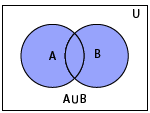
Fig. 1: A ∪ B operation
Let A and B be any two sets. The union of A and B is the set that consists of all the elements of A and all the elements of B, the common elements being taken only once. The symbol ‘∪’ is used to denote the union. Symbolically, we write A ∪ B which is usually read as A union B.
Example: A = {1, 2, 4, 8} and B = {2, 8, 10, 12}. Find A ∪ B.
Solution: We wiil get all element of both set A and B.
Answer: A ∪ B = {1, 2, 4, 8, 10, 12}
A ∩ B
The set of all the items that are a part of both sets A and B is the intersection of those two sets.
The shaded portion in the figure below indicates the intersection of A and B.
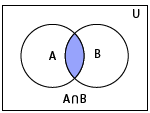
Fig. 2: A ∩ B operation
The set of all elements shared by sets A and B is called the intersection of those sets. The intersection is indicated by the symbol "∩." The set of all the items that are a part of both sets A and B is the intersection of those two sets. We can express A ∩ B = {x: x ∈ A and x ∈ B} symbolically.
Example: A = {9, 4 ,6, 8} and B = {9, 4 ,56, 35, 87} Find A ∩ B.
Solution: We will get common elements of both set A and B.
Answer: A ∩ B = { 9, 4 }
(A ∪ B)'
The intersection of the complements of the two sets A and B is the union B complement.
The shaded portion in Fig. 3 indicates the (A ∪ B)'
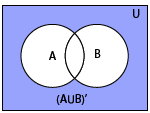
Fig. 3: (A ∪ B)' operation
Example: Determine the elements of A union B complement if U = {3, 4, 5, 6, 7, 8, 9}, A = {5, 7, 8},and B = {4, 3, 6}
Solution: We have A = {5, 7, 8}, and B = {4, 3, 6}, then A U B is given by,
A U B = {3, 4, 5, 6, 7, 8}, then A union B complement is given by, (A ∪ B)' = U - (A ∪ B)
= {3, 4, 5, 6, 7, 8, 9} - {3, 4, 5, 6, 7, 8}
= {9}
Answer: (A ∪ B)' = {9}
(A ∩ B)'
A intersection B All elements of the universal, with the exception of those in the intersection of sets A and B, make up the complement.
The union of the complements of sets A and B is the intersection B complement. It can be expressed mathematically as (A ∩ B)' = A' U B'. (A ∩ B)' = A' U B'.
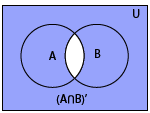
Fig. 4: (A ∩ B)' operation
Example: Consider U = {1,2,3,4,5,6,7,8,9,10} and A = {1, 2, 3, 4, 5} and B = {2, 4, 6, 8, 10}. Find the elements in A intersection B complement.
Solution : We know that
A ∩ B = {1, 2, 3, 4, 5} ∩ {2, 4, 6, 8, 10}
= {2,4}
⇒ (A ∩ B)' = {1, 3, 5, 6, 7, 8, 9, 10}
Answer: The elements in A intersection B complement are {1, 3, 5, 6, 7, 8, 9, 10}.
A′
The collection of all elements of U that are not elements of A is the complement of A. To represent the complement of A with regard to U symbolically, we write A′.A′ = {x: x ∈ U and x ∉ A} as a result.
Example:
Let U be the universal set which consists of all prime numbers and A be the subset of U which consists of all those prime numbers that are not divisors of 42. Thus,
A = {x : x ∈ U and x is not a divisor of 42}.
We see that 2 ∈ U but 2 ∉ A, because 2 is divisor of 42.
Similarly, 3 ∈ U but 3 ∉ A, and 7 ∈ U but 7 ∉ A. Now 2, 3 and 7 are the only elements of U which do not belong to A.
The set of these three prime numbers, i.e., the set {2, 3, 7} is called the complement of A with respect to U, and is denoted by A′. So we have A′ = {2, 3, 7}.
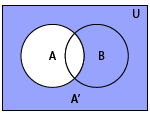
Fig. 5: A′ operation
A'∪B
(A’∪B) is the set of elements x such that x is not an element of A or x is an element of B.
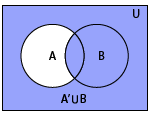
Fig. 6: A'∪B operation
The shaded portion represents A'∪B.
Example: U = {22, 25, 26, 5, 4, 10} and A = {5, 25, 10} and B = {22, 4}. Find A′∪B.
Solution: We note that 5, 25, 10 are the only elements of A that cannot be included in the A'∪B operation.
Answer: A′∪B = {22, 4, 26}
A'∩B
Create a Venn diagram for each set described in the problem, which is A' and B. then add them together, this will give the union of both sets. The A'∩B excludes the intersection of the sets and includes only the elements that belong to set B.
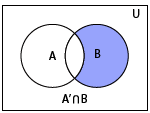
Fig. 7: A'∩B operation
The shaded portion represents A'∩B.
Example: U = {3, 8, 6, 2, 7, 10, 12, 36, 85, 56, 47} and A = {3, 2, 12, 85} and B = {8, 6, 7, 10, 36}. Find A′∩B.
Solution: We note that 8, 6, 7, 10, and 36 are the only elements of B that can be included in the A'∩B operation.
Answer: A′∩B = {8, 6, 7, 10, 36}
A ∩ B = ∅
The sets A and B are called disjoint if they have no common elements or if the intersection of A and B is the empty set.
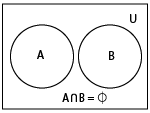
Fig. 8: A ∩ B = ∅ operation
Example : U = {9, 5, 6, 3, 86, 32, 74} and A = {6, 86, 74 } and B = {9, 5, 3, 32}. Find A'∩ B = ∅.
Solution: We note that both A and B sets are disjoint sets, and their elements do not belong to each other.
Answer: A'∩ B = ∅ = null.
A⊂B
A set A is a subset of another set B if all elements of the set A are elements of the set B. In other words, set A is contained inside set B. The subset relationship is denoted as A⊂B.
The symbol ⊂ stands for ‘is a subset of’ or ‘is contained in’.
- Every set, such as A ⊂ A and B ⊂ B, is a subset of itself.
- Every set has an empty set as a subset.
- A ⊂ B denotes that A is either contained in B or is a subset of B.
- B contains A if B ⊂ A.
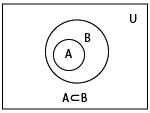
Fig. 9: A⊂B operation
Example: U = {9, 2, 4, 6, 8, 12 } and A = {2, 4, 6} and B = {6, 4, 8, 2}. Find A⊂B.
Solution: We note that here A is a subset of B. Since all the elements of set A are contained in set B, B is not a subset of set A. Since all the elements of set B are not contained in set A, every element of A is in B, but B has more elements.
Answer: A⊂B = {2, 4, 6, 8}