
Photosynthesis Explained: A Complete Guide for Students
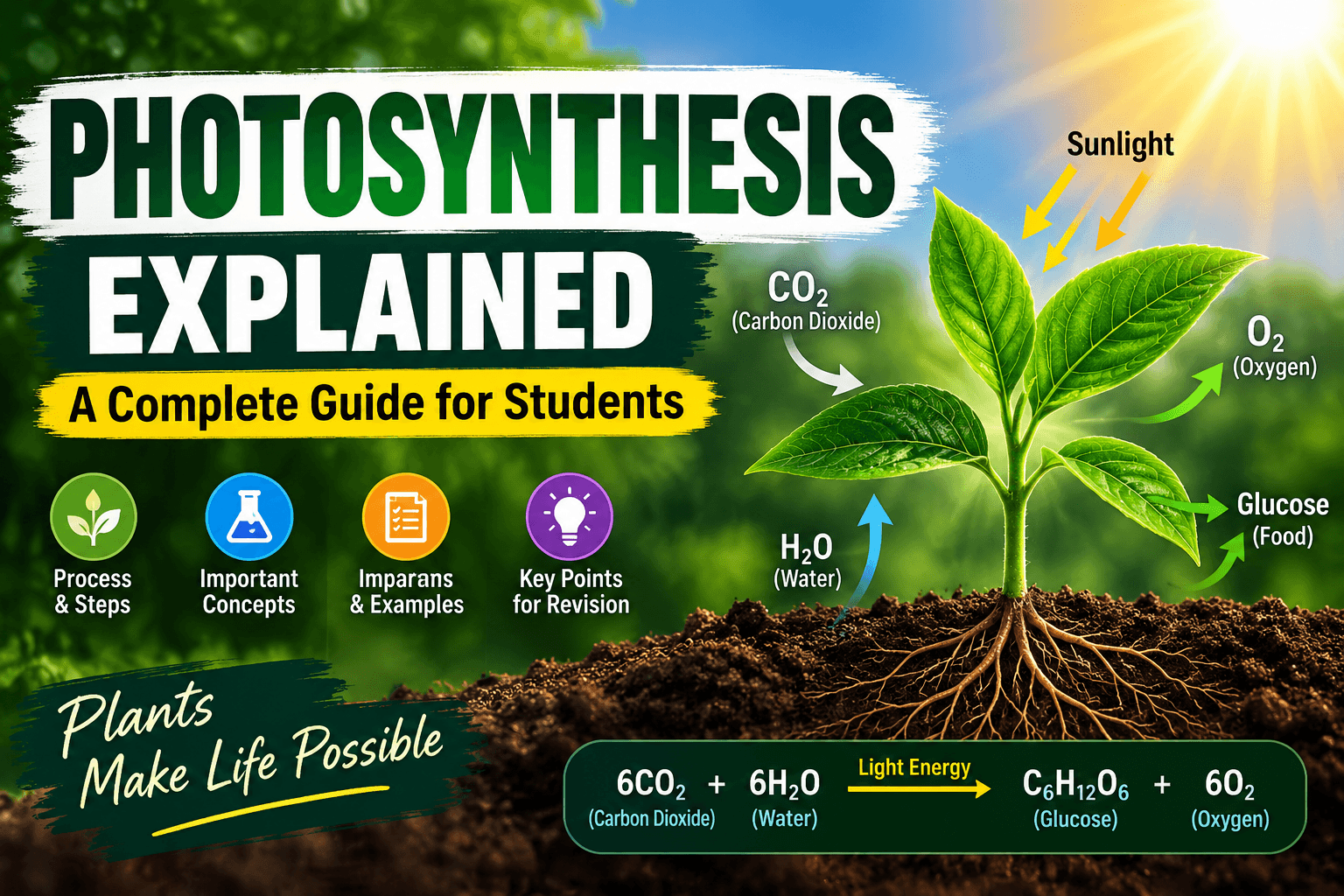
Understand how green plants convert solar radiance into chemical energy, the two-stage biochemical pathway, and the core factors governing glucose synthesis.
Photosynthesis is the physicochemical process by which photosynthetic organisms synthesize organic compounds (glucose) from carbon dioxide and water using sunlight absorbed by chlorophyll. The overall balanced chemical formula is: 6CO₂ + 6H₂O + Solar Energy → C₆H₁₂O₆ + 6O₂. It occurs inside chloroplasts via Light Reactions (thylakoids) and Dark Reactions / Calvin Cycle (stroma).
1. Site of Photosynthesis: Inside the Chloroplast
Photosynthesis occurs primarily in the mesophyll cells of plant leaves inside specialized double-membrane organelles called chloroplasts. Chloroplasts contain two operational zones:
- Grana (Thylakoid Stacks): Disk-like sacs containing chlorophyll pigments, electron transport complexes, and ATP synthase enzymes. This is where light energy is harvested.
- Stroma: The aqueous fluid surrounding thylakoids containing soluble enzymes, including RuBisCO, where enzymatic carbon fixation takes place.
2. Two Sequential Phases of Photosynthesis
| Feature | Light-Dependent Phase | Light-Independent Phase (Calvin Cycle) |
|---|---|---|
| Primary Site | Thylakoid Membrane | Stroma of Chloroplast |
| Sunlight Requirement | Directly Required | Indirect (Uses products of light reaction) |
| Primary Inputs | H₂O, Light, NADP⁺, ADP | CO₂, ATP, NADPH |
| Key End Products | Oxygen (O₂), ATP, NADPH | Glucose (Sugar), ADP, NADP⁺ |
- Light Reactions: Photons strike photosystems (PS II and PS I), exciting electrons. Water molecules undergo photolysis, releasing O₂ as a byproduct while generating assimilatory power (ATP and NADPH).
- Dark Reactions (Calvin Cycle): Utilizing RuBisCO enzyme, CO₂ is fixed into 3-PGA, reduced using ATP and NADPH, and converted into glucose.
Bihar Board 12th Science - English Hindi both Medium (2026-2027)
Master Class 12th Plant Physiology, Genetics, and Board Biology concepts with interactive live classes, revision notes, and test series.
Download App & Enroll Now3. Factors Regulating Photosynthetic Rate
Photosynthesis is governed by Blackman's Law of Limiting Factors. If multiple factors affect a chemical process, its rate is constrained by the factor closest to its minimal value:
- Light Intensity: Increases the rate up to a light saturation point; beyond this, chlorophyll photo-oxidation occurs.
- Carbon Dioxide Concentration: CO₂ is typically the chief limiting factor under natural conditions (saturation occurs at ~0.05% concentration).
- Temperature: Dark reactions are purely enzymatic and exhibit an optimum range between 25°C and 35°C. Excessive heat denatures catalytic enzymes.
- Water Availability: Water deficit induces stomatal closure, choking CO₂ intake and reducing leaf surface area.
Bihar Board 11th Science परिवर्तन बैच (Hindi & English Both Medium) 2026-27
Build an unshakeable base in Class 11th Botany, Zoology, Physics, and Chemistry. Prepare with Bihar's top educators.
Join Parivartan Batch TodayFrequently Asked Questions (FAQs)
Where does the oxygen released during photosynthesis originate?
Oxygen comes from the photolysis (splitting) of water molecules (H₂O) during the light reaction, not from carbon dioxide (as demonstrated by Cornelius van Niel and verified via isotope tracing).
Why is RuBisCO termed the most abundant enzyme on Earth?
Ribulose-1,5-bisphosphate carboxylase-oxygenase (RuBisCO) drives the primary carboxylation step across all photosynthetic plant life, constituting up to 50% of soluble leaf protein.
Does the dark reaction only happen at night?
No. The dark reaction (Calvin cycle) does not require photons directly, but relies directly on ATP and NADPH synthesized during light exposure, making it actively proceed during daytime.