
Why Does a Catalyst Increase Reaction Rate? Explained Simply
Quick Answer
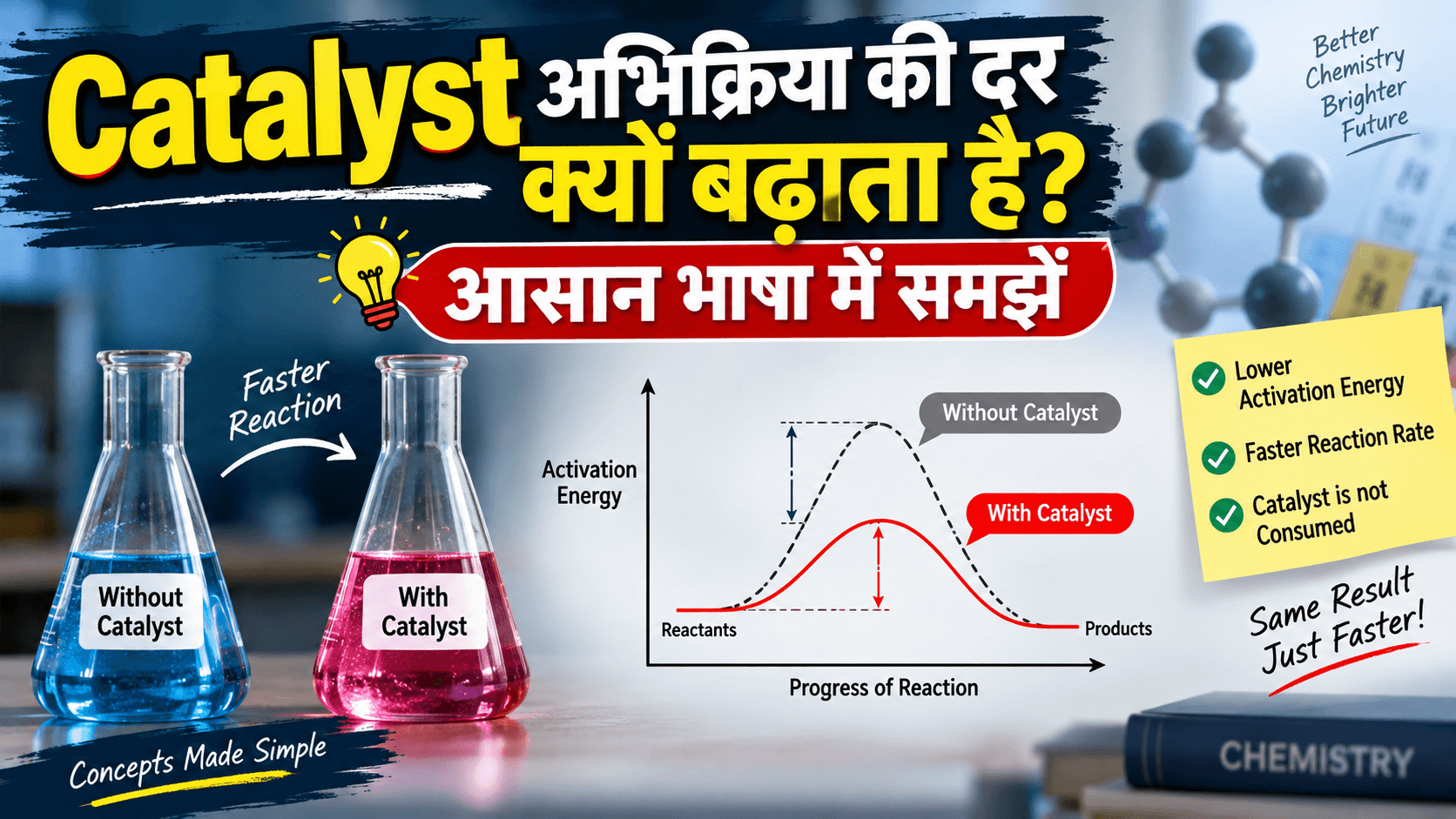
A catalyst increases the reaction rate by providing an alternative reaction pathway with lower activation energy. Because of this, more reactant molecules can react successfully, making the reaction faster.
What is a Catalyst?
A catalyst is a substance that changes the rate of a chemical reaction without being permanently consumed in the overall reaction.
In simple terms, a catalyst gives the reaction an easier route to reach the products.
What is Activation Energy?
Activation energy is the minimum amount of energy required to start a chemical reaction.
Easy Example
Imagine a mountain that you need to cross. If the mountain is very high, you need more energy to cross it. A catalyst provides an easier, lower route. This lower route represents lower activation energy.
How Does a Catalyst Increase Reaction Rate?
- A catalyst provides an alternative reaction pathway.
- This pathway has lower activation energy.
- More reactant molecules can achieve the required energy.
- The number of successful or effective collisions increases.
- As a result, the reaction occurs faster.
Remember This
Catalyst → Lower Activation Energy → More Effective Collisions → Faster Reaction
Catalyst and Collision Theory
According to collision theory, a chemical reaction occurs when particles collide with sufficient energy and suitable orientation.
A catalyst lowers the activation energy. Therefore, at the same temperature, more particles can participate in successful collisions, increasing the reaction rate.
Does a Catalyst Change Chemical Equilibrium?
No. A catalyst does not change the position of chemical equilibrium. It speeds up both the forward and reverse reactions, helping the system reach equilibrium faster.
Important Points About Catalysts
A catalyst provides an alternative pathway with lower activation energy.
More effective collisions occur, increasing the reaction rate.
The catalyst is not permanently consumed in the overall reaction.
Board Exam Tip
For the question "Why does a catalyst increase the rate of reaction?", write: "A catalyst provides an alternative pathway with lower activation energy."
Frequently Asked Questions (FAQs)
1. Why does a catalyst increase reaction rate?
A catalyst provides an alternative pathway with lower activation energy, making the reaction faster.
2. Does a catalyst reduce activation energy?
Yes. It provides an alternative reaction pathway that has a lower activation energy.
3. Is a catalyst consumed in a reaction?
A catalyst may participate in the reaction mechanism, but it is not permanently consumed overall.
4. Does a catalyst change equilibrium?
No. It does not change the equilibrium position; it only helps equilibrium be reached faster.
5. What is activation energy?
Activation energy is the minimum energy required for a chemical reaction to occur.
Bihar Board Science Preparation

Conclusion
A catalyst increases reaction rate by providing an alternative pathway with lower activation energy. This allows more particles to undergo effective collisions, making the reaction faster.