
pH Determination of Different Solutions
📖 Introduction
pH is a numerical scale used to determine the acidic or basic nature of a solution. The pH scale generally ranges from 0 to 14. A solution with a pH below 7 is acidic, a pH of 7 is neutral, and a pH above 7 is basic or alkaline.
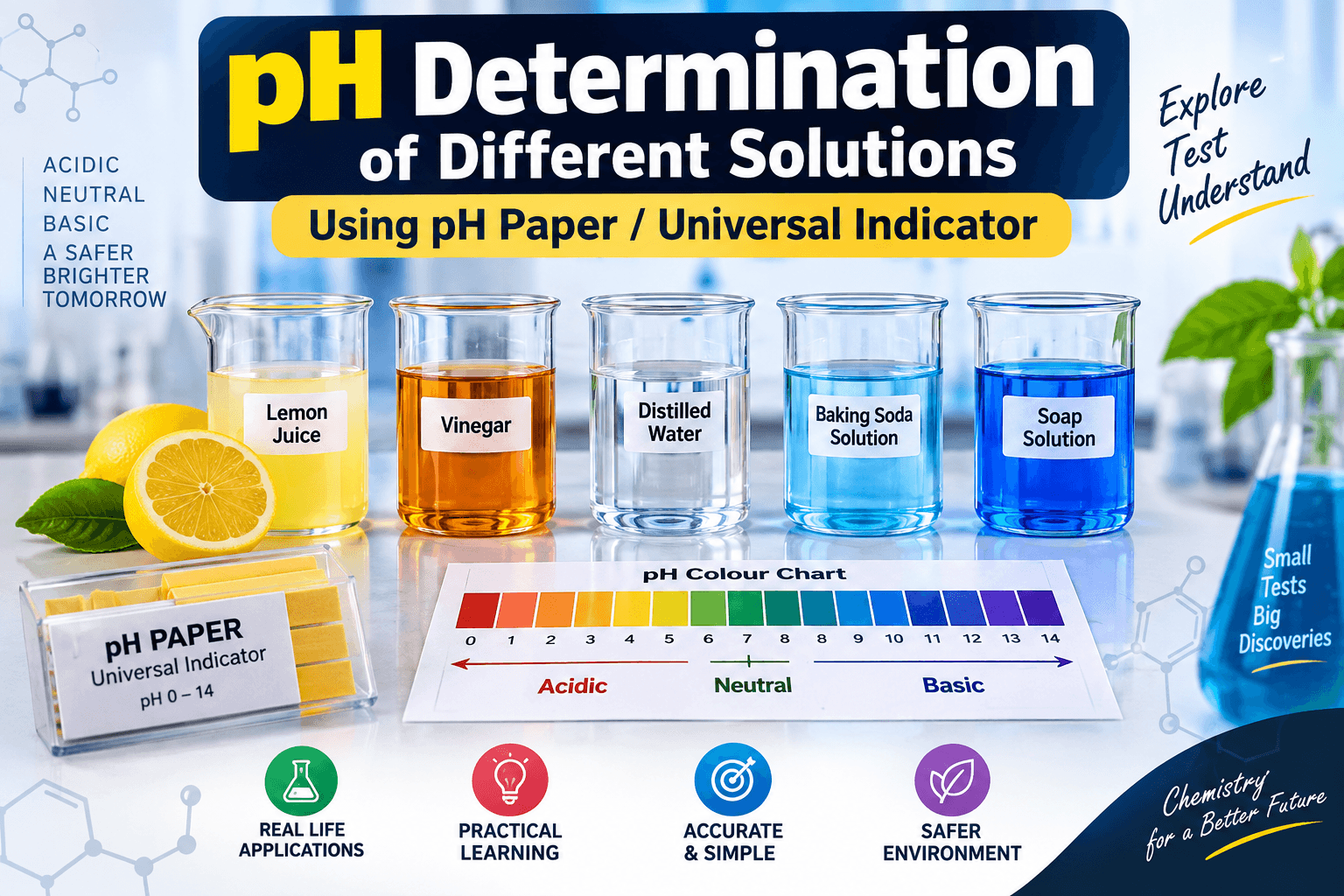
In this experiment, the approximate pH of common solutions such as lemon juice, vinegar, distilled water, baking soda solution and soap solution is determined using pH paper or a universal indicator.
- pH < 7: Acidic solution
- pH = 7: Neutral solution
- pH > 7: Basic solution
🎯 Objective
- To determine the approximate pH of different solutions.
- To identify acidic, neutral and basic solutions.
- To learn the practical use of pH paper and universal indicator.
- To understand the importance of the pH scale.
- To compare the relative acidity and basicity of common substances.
🧪 Materials Required
- pH Paper or Universal Indicator
- Test Tubes
- Dropper
- White Tile
- Lemon Juice
- Vinegar
- Distilled Water
- Baking Soda Solution
- Soap Solution
- Test Tube Stand
⚗️ Theory
The pH concept was introduced by Danish chemist Søren Peder Lauritz Sørensen in 1909. The pH of a solution is related to the concentration of hydrogen ions (H⁺) present in it.
A higher concentration of hydrogen ions generally results in a lower pH and indicates greater acidity. A lower hydrogen ion concentration generally corresponds to a higher pH and indicates basic nature.
pH = −log[H⁺]
A universal indicator is a mixture of several indicators that produces different colours at different pH values. By comparing the observed colour with a standard colour chart, the approximate pH of a solution can be estimated.
🌈 pH Colour Guide
| pH Range | Approximate Colour | Nature |
|---|---|---|
| 0–3 | Red | Strongly Acidic |
| 4–6 | Orange / Yellow | Weakly Acidic |
| 7 | Green | Neutral |
| 8–10 | Blue | Weakly Basic |
| 11–14 | Dark Blue / Violet | Strongly Basic |
🔬 Procedure
- Take clean and labelled test tubes for each solution.
- Pour a small amount of each solution into the respective test tube.
- Place a small strip of pH paper on a clean white tile.
- Using a clean dropper, place one or two drops of the solution on the pH paper.
- Observe the colour change immediately.
- Compare the colour with the standard pH colour chart.
- Record the approximate pH value.
- Classify the solution as acidic, neutral or basic.
- Repeat the same procedure for all the given solutions.
📊 Observation Table
| Solution | Observed Colour | Approx. pH | Nature |
|---|---|---|---|
| Lemon Juice | Red-Orange | 2–3 | Acidic |
| Vinegar | Orange | 3–4 | Acidic |
| Distilled Water | Green | ≈7 | Neutral |
| Baking Soda Solution | Blue | 8–9 | Basic |
| Soap Solution | Blue-Violet | 9–11 | Basic |
Note: Actual pH values may vary depending on the concentration and composition of the samples.
🌍 Applications
- Testing the quality of drinking and laboratory water.
- Determining soil pH in agriculture.
- Monitoring pH in swimming pools.
- Checking acidity in food and beverages.
- Environmental water and soil analysis.
- Controlling pH during laboratory experiments.
⚠️ Precautions
- Use clean and dry test tubes.
- Always use fresh pH paper.
- Do not touch the indicator portion of the pH paper.
- Use separate droppers for different solutions.
- Observe the colour immediately after adding the sample.
- Do not taste or directly touch any laboratory solution.
✅ Result
The approximate pH of different solutions was successfully determined using pH paper or a universal indicator. Lemon juice and vinegar were acidic, distilled water was approximately neutral, while baking soda solution and soap solution were basic.
🎓 Viva Questions
- What is pH?
- What is the pH of a neutral solution?
- What does a pH below 7 indicate?
- What does a pH above 7 indicate?
- Who introduced the pH concept?
- What is the use of a universal indicator?
- Why is lemon juice acidic?
- Why is soap solution generally basic?